

How to Spot Hidden Leaks Before Damage Spreads
A leak behind a wall or beneath a floor can cause serious damage long before water appears in the room. Knowing how to spot hidden leaks gives you the chance to act early, protect your property and avoid a much larger repair bill. The key is noticing small changes – an unexplained increase in water use, a musty odour or a patch of paint that no longer looks quite right.
Hidden leaks are common in homes of every age, from period properties with ageing pipework to newer homes where a failed fitting is concealed behind a kitchen unit. They can affect mains water pipes, central-heating pipework, shower supplies, appliances and drainage connections. Some need urgent attention, while others develop slowly, but none are best left to chance.
How to spot hidden leaks around your home
Start by trusting changes you cannot easily explain. A sudden damp patch is an obvious warning sign, but a hidden leak often shows itself more quietly. You may notice a persistent stale or musty odour in one room, peeling wallpaper, bubbling paint, warped skirting boards or flooring that feels unusually soft underfoot.
Ceilings deserve particular attention. A brown mark, a slightly sagging area or a new line in the paint beneath a bathroom, loft tank or upstairs radiator pipe can point to water travelling through the structure. Water does not always appear directly below the fault, so the visible stain may be some distance from the leaking pipe or fitting.
Listen as well as look. Pipes should not continue to hiss, trickle or make a rushing sound when taps, showers, washing machines and dishwashers are off. A faint noise inside a boxed-in section of pipework can be difficult to locate, but it is worth investigating rather than assuming it is normal.
Check your water meter for unexplained use
Your water meter can provide one of the clearest early checks for a leak on the mains water supply. First, make sure no one is using water. Turn off taps, showers, washing machines, dishwashers and any appliance that may draw water automatically. Avoid carrying out the test when a toilet cistern may be refilling.
Take a reading from the meter, then leave water unused for at least 30 minutes, or preferably a couple of hours. If the reading changes, water is being used somewhere in the property. That may be a hidden leak, although it could also be a toilet that is silently running, an appliance connection or an outdoor tap.
This test is useful, but it has limits. It will not always reveal a leak in a sealed central-heating system, and it can be less straightforward in blocks of flats or properties with a shared supply. If you are unsure which meter serves your home, or the result is unclear, a plumber can test the system properly without guesswork.
Watch your water bill and water pressure
An unexpectedly high water bill is often the first sign a slow leak has been present for weeks or months. Compare your current usage with the same period last year, allowing for guests, school holidays, garden watering or changes in household routine. A gradual increase without a clear reason is worth checking.
Low water pressure can also be a clue, particularly if one shower or tap has become weaker than usual. However, pressure problems do not automatically mean a leak. They may be caused by a blocked tap aerator, a faulty pressure-reducing valve, work on the local water network or an issue with a specific appliance. A qualified engineer can identify whether the problem is on your pipework or elsewhere.
Outside, look for an area of lawn that stays greener, softer or wetter than the ground around it. Water pooling near an external wall, a driveway or an outside tap may indicate a leak in a buried supply pipe. During dry weather, these differences can be especially noticeable.
Check toilets, bathrooms and kitchen units
A toilet is one of the most common sources of wasted water because an internal leak can be almost silent. Put a few drops of food colouring into the cistern and wait without flushing. If colour appears in the pan, the flush valve or siphon may be allowing water through. This is not usually an emergency, but it can waste a surprising amount of water and increase your bills.
In bathrooms, check around shower screens, bath panels, basin pedestals and tiled walls. Failed sealant is not always a plumbing leak, but water getting behind a shower tray or bath can damage floors and ceilings below just as severely. Look for cracked grout, loose tiles, black mould returning quickly after cleaning or swollen timber around the bathroom door frame.
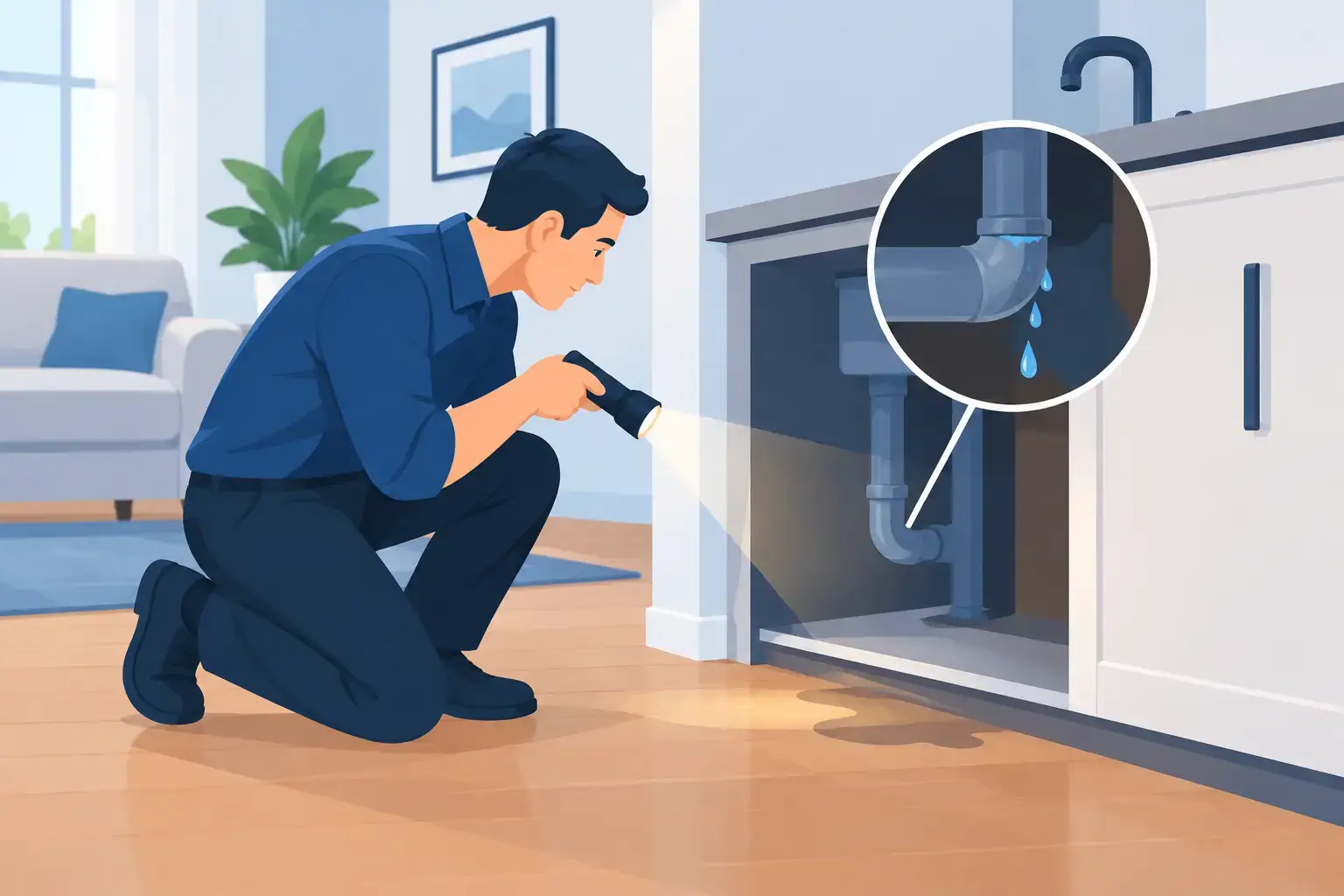
Under kitchen and utility-room sinks, run your hand carefully around accessible pipe joints and valves. A dry-looking cupboard can still conceal a slow leak, so check for a damp cabinet base, staining, rust on fittings or a persistent smell. Do not disturb pipework if a connection looks corroded or unstable.
Do not ignore changes in your heating system
Leaks from central-heating pipework can remain hidden beneath floors or within walls. One common warning sign is a boiler pressure gauge that repeatedly drops. If you are topping up the pressure more than occasionally, the system should be checked. A small leak may be present, although the cause could instead be a faulty expansion vessel, pressure relief valve or another boiler component.
Look around radiators, radiator valves and visible pipe joints for staining or tiny deposits. A greenish or white residue can indicate a slow seep. You may also find that certain rooms take longer to warm up, radiators need frequent bleeding or the boiler loses pressure after operating.
Do not keep repressurising a system indefinitely. Adding fresh water again and again can contribute to internal corrosion and may make a minor fault more costly over time. A heating engineer can investigate the pressure loss and advise whether a repair, component replacement or further leak detection is needed.
Know when to turn off the water and call for help
If water is actively coming through a ceiling, pooling near electrical sockets, flooding a room or running from a pipe, turn off the mains water supply at the internal stopcock if it is safe to do so. The stopcock is commonly located under the kitchen sink, in a utility room, cloakroom, cupboard or near where the water supply enters the property. Every homeowner, landlord and property manager should know where it is and check that it can still be operated.
Switch off electricity only if you can do so safely and water has affected electrical fittings. Never touch wet switches, sockets or appliances. Move belongings away from the affected area where possible, but do not remove ceiling panels, lift floors or cut into walls to trace the source yourself. That can worsen the damage and create avoidable safety risks.
A professional inspection is sensible when you have repeated pressure loss, meter movement with no water use, persistent damp, mould with no obvious condensation cause, or any stain that is growing. Leak detection may involve pressure testing, moisture readings, thermal checks or targeted inspection, depending on the type and location of the pipework. The aim is to find the fault with as little disruption as practical.
For properties in Cheltenham, Gloucestershire, the Cotswolds, Bath or Stroud, Plumbing Bend Heating Service Ltd can investigate suspected plumbing and heating leaks, carry out repairs and help prevent further damage. Early action is nearly always less disruptive than waiting for a hidden fault to become visible.
A hidden leak rarely fixes itself. If something in your home has changed – even if it seems minor – make a note of it, carry out the simple checks you can do safely and arrange expert help before damp becomes damage.