

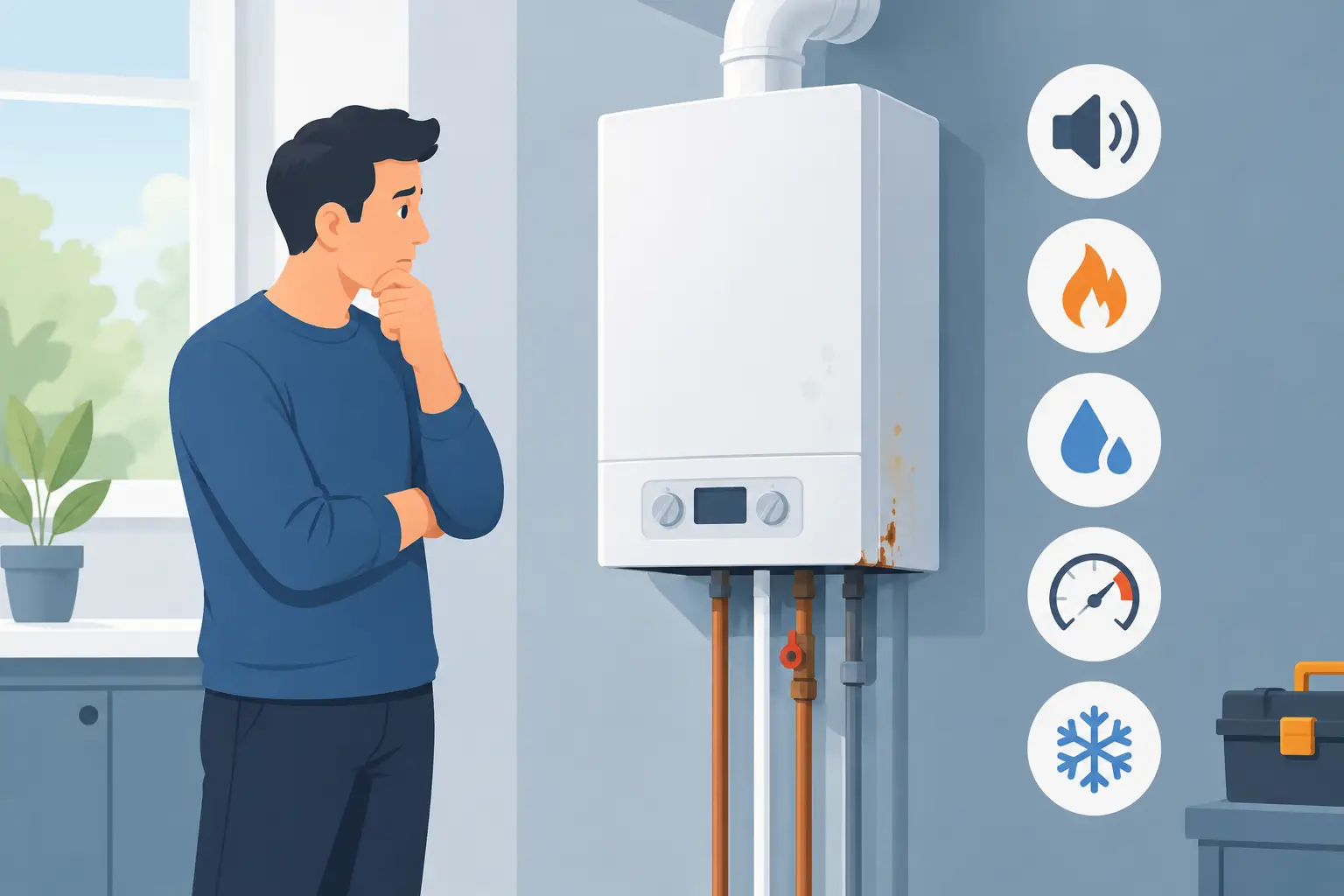
Top Signs Your Boiler Needs Replacement Now
A boiler rarely fails at a convenient time. It may start with a cold radiator upstairs, a pressure gauge that keeps dropping, or a repair that holds for only a few weeks. Knowing the top signs your boiler needs replacement helps you plan before a small fault leaves your home without heating or hot water.
Replacement is not always the first answer. Many boiler problems can be repaired safely and cost-effectively, particularly on newer, well-maintained models. However, an ageing boiler with repeated faults can become expensive, inefficient and unreliable. A Gas Safe engineer can assess its condition and give you clear advice on whether repair or replacement represents better value.
Top signs your boiler needs replacement
1. Your boiler is more than 10 to 15 years old
A boiler can last beyond 15 years with regular servicing and timely repairs, but its age should still influence your decision. Older boilers are generally less efficient than modern condensing models and may use more gas to deliver the same level of warmth.
Age also makes repairs harder. Parts for older models can become difficult to source or costly to fit, especially if the manufacturer no longer supports that range. If a major component fails on an older boiler, paying for a replacement can make more sense than putting more money into a system nearing the end of its working life.
2. Breakdowns are becoming a regular occurrence
One isolated fault does not mean you need a new boiler. A failed valve, pump or sensor can often be repaired quickly. The concern is a pattern of call-outs, particularly when different components fail over a short period.
Keep track of repairs, including the cost and the time your household has spent without reliable heating or hot water. If you are arranging an engineer visit every winter, or a repair costs a substantial proportion of a new installation, replacement may provide a more dependable long-term solution.
3. Your heating bills are rising without a clear reason
Energy prices matter, but a noticeable increase in gas use can also point to a boiler that is no longer operating efficiently. An ageing appliance may take longer to heat your water and radiators, cycling more often and wasting fuel in the process.
Before deciding the boiler is at fault, consider other causes. Poor insulation, a change in household routines, incorrect heating controls or a problem with the central heating system can all affect consumption. A qualified engineer can check boiler performance, controls and system water quality to identify what is driving the higher bills.
4. The boiler loses pressure repeatedly
It is normal for pressure to change slightly as your heating warms up and cools down. It is not normal to need to repressurise the boiler regularly. Persistent pressure loss could result from a leak in the heating system, a faulty expansion vessel, an issue with the pressure relief valve or an internal boiler fault.
A repair may be straightforward, but do not simply keep topping up the pressure. Frequent refilling introduces fresh water into the system, which can contribute to corrosion and sludge over time. An engineer should find the underlying cause and advise whether it is economical to repair.
5. You can see leaks, corrosion or staining
Water around the boiler, pipework corrosion or staining on the casing should never be ignored. Even a slow leak can damage internal parts, reduce system pressure and affect surrounding cupboards, walls or flooring.
Leaks are not always visible at the boiler itself. You may notice marks beneath radiator valves, damp patches around pipework or an unexplained drop in pressure. Arrange an inspection promptly. A leaking boiler may be repairable, but widespread corrosion or a failed heat exchanger can make replacement the safer and more practical option.
6. Your home has cold radiators and uneven heating
If some rooms are comfortable while others remain cold, the boiler is not necessarily to blame. Radiators may need bleeding, balancing or powerflushing, and a faulty thermostat or zone valve can prevent heat reaching parts of the property.
That said, an older boiler may struggle to circulate heat effectively, particularly if the system has years of sludge build-up. If your boiler is slow to respond, makes unusual noises and cannot maintain a comfortable temperature after servicing and system cleaning, upgrading it can improve both comfort and control.
7. It is making new or worsening noises
Boilers are not silent, but banging, whistling, gurgling and persistent vibrating noises deserve attention. These sounds can be caused by trapped air, low water pressure, a failing pump, debris in the system or a condition known as kettling, where restricted water flow causes overheating inside the heat exchanger.
The right repair depends on the cause. Powerflushing may help a contaminated heating system, while a failing heat exchanger on an older appliance can be a more serious and expensive issue. Do not assume a noisy boiler is simply part of living in an older property.
8. Hot water is inconsistent
A combi boiler should provide dependable hot water on demand. If your shower turns cold without warning, taps take much longer to heat up, or water temperature fluctuates, the boiler may need attention.
Common causes include a faulty diverter valve, plate heat exchanger, sensor or thermostat. Some of these faults are repairable, but repeated hot-water problems can be a strong indication that an older boiler is becoming unreliable. This is especially frustrating for households with busy mornings, tenants or customers using the property.
9. Repairs are no longer good value
The practical question is not simply, “Can this boiler be repaired?” It is, “Will this repair give us reliable service for a reasonable time?” A lower-cost repair on a relatively new boiler is often sensible. A costly repair on a 14-year-old appliance that has already broken down twice this year may not be.
Ask for a clear explanation of the fault, the likely lifespan after repair, parts availability and the full cost of replacement. A transparent comparison makes it easier to decide with confidence rather than making a rushed choice during a breakdown.
10. Your boiler has a safety concern or fails its service checks
A boiler should be serviced annually by a Gas Safe registered engineer. During a service, the engineer checks safe combustion, ventilation requirements, flue condition, components and overall operation. If the boiler repeatedly fails safety-related checks, has a deteriorated flue or has significant internal corrosion, replacement may be necessary.
If you smell gas, suspect a carbon monoxide leak, see a yellow or orange flame instead of a crisp blue flame, or your carbon monoxide alarm sounds, treat it as urgent. Turn off the appliance if it is safe to do so, open windows, leave the property and contact the appropriate emergency gas service. Do not attempt to investigate or repair a gas appliance yourself.
Repair or replace: making the right call
There is no fixed age at which every boiler must be replaced. A well-looked-after boiler with a minor, isolated fault may have years of reliable life remaining. Equally, a newer boiler with installation issues or poor water quality may need more than a simple repair.
A proper assessment should consider the boiler’s age, fault history, repair cost, energy performance, household hot-water demand and the condition of the wider heating system. For landlords and property managers, reliability, tenant comfort and compliance also need to be part of the decision.
When replacement is the right route, it is worth looking beyond the boiler itself. Correct sizing, suitable controls, clean system water and professional commissioning all affect how well the new appliance performs. Installing an oversized or poorly configured boiler can undermine the savings and comfort you expected.
If your boiler is showing one or more of these warning signs, arranging an inspection early gives you more choice and avoids the pressure of an unexpected cold-weather failure. Plumbing Bend Heating Service Ltd can assess your boiler and central heating system, explain the options plainly and help you choose a safe, efficient solution that will serve your property well.